What Happens Every Time You Send "Hi"
We all know how AI keeps changing the way we work, learn, and also entertain us. But here is something most people don’t realize — Every “Hi” you send to ChatGPT or any other AI assistants brings a huge reaction inside Data centers.
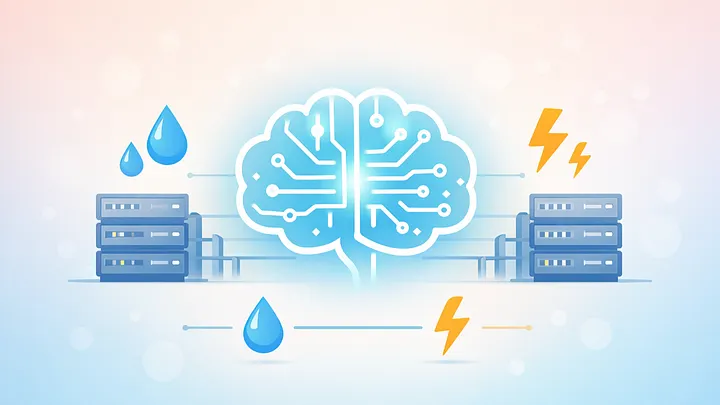
These data centers contain thousands of powerful computers. When you type a message, they generate heat. To keep them cool, air conditioning and water‑based cooling systems are used. The end result? Massive amounts of pure water and electricity are consumed.
Even AI Feels Thirsty
The recent research shows that by asking 20 questions to ChatGPT or any other AI assistants consumes about half a litre of pure water for cooling the servers.
Now, scale that up:
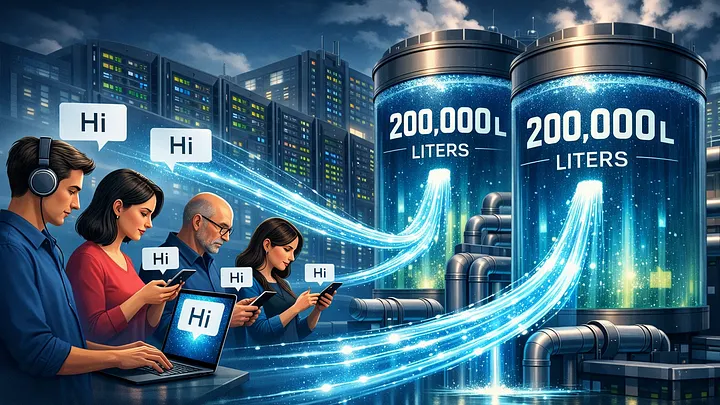
Just imagine: If 10 million people casually say “Hi” to ChatGPT, about 200,000 litres of pure water is consumed which is enough drinking water for thousands of families — but instead, it’s used just to keep the servers cool.
The Electricity Bill For AI
AI doesn’t just feel thirsty — it’s hungry for electricity too. Training big models in AI and running servers in data centers requires a huge amount of power. Experts predict that the total electricity used in U.S. will grow by 10% more each year because of AI. Instead of powering lights, fans, or fridges, all that energy is going into GPUs, servers, and cooling towers.
Here is the unknown cost, every casual “Hi” you send consumes power, burns electricity, and releases carbon dioxide. Researchers estimate that when millions of people casually ping ChatGPT, the carbon emission can reach up to 20 tons in a single day.
AI is expected to make America’s electricity bill grow much faster than usual.
The Damage You Don't See
This energy surge doesn’t just affect tech companies. It ripples into everyday life: This doesn’t only affect Tech companies. It affects the world in so many ways:
- Electricity Price — the overall demand for electricity goes up, when demand rises the price increases. Your monthly electricity bill at home could get more expensive, even though you’re not the one running those AI servers.
- Quality of Water — The water that is discharged after used for cooling into rivers or lakes affects aquatic life.
- Climate impact — AI servers run on huge amounts of electricity, and much of that power in the U.S. still comes from fossil fuels like coal, oil, and natural gas. Burning these fuels releases carbon dioxide (CO₂), which leads to global warming.
- Noise and heat pollution — Data centers run 24/7 with giant cooling fans, creating constant noise and releasing waste heat that can raise local temperatures.

Think Before You Type
AI is more powerful than we imagine, but it’s not free. Every text consumes electricity, water, and other resources. That doesn’t mean we should stop using it — it means we should start using it wisely.
Stop chatting with AI like it’s your friend. Instead of sending ten casual “Hi” messages, send one clear prompt and get what you need.
This won’t save the world overnight, but it can reduce the hidden damage AI causes. Small changes in how we use AI make a big differences for the planet.
AI is booming everywhere, but water and electricity are not infinite.
So here’s a thought to leave you with:
Do you think the AI revolution will slow down because of resource limits before it slows down because of technology limits?